I’ve got a bit of a surprise for you all today. In running a blog I often get requests to host guest bloggers on the site. That said, none of the proposed topics thus far have ever had anything at all to do with history or the effect of history upon our lives, which is really the gist of this modest venue. Tiring of first turning down and then ignoring the endless requests to host blog entries on revolutionary vacuum cleaners, extreme colon care, and underwater basket weaving, I decided to take a different tack and instead actively sought out the kind of contributor I want on the site and who I think you’ll find interesting. You’ll see guest bloggers from time to time going forward and I hope you enjoy them and their content as much as I do.
With that in mind, today represents a first for me as I welcome Doctor Michael MacArthur Bosack to the blog. I consider Dr. Bosack a close and trusted friend, and you should know he and I served together in both Japan and Korea where he distinguished himself as a talented alliance manager and a shrewd negotiator. Like me, he served in a time of war and deployed to Afghanistan, but unlike me, he transitioned from military to government civilian service midway through his career. In his most recent position as Deputy Secretary of the United Nations Command Military Armistice Commission (UNCMAC), charged with maintaining the 1953 armistice in Korea, he added peacebuilder to his line of already noteworthy credentials. Today, he is the founding director of Parley Policy Institute, an Australia-based institute specializing in the analysis, mediation, and prevention, where possible, of conflict around the world. He has more publications to his credit than I have room to mention here but you can easily find his articles in the Japan Times, the Diplomat, the Kyiv Post, and NK News. As well I’ve included at the bottom of this page an additional button for any of you who want to check out the many interesting informational products available at the Parley Policy Institute website.
Okay … not intending to gild the lily any further, I present to you Dr. Michael Bosack and “Forcing the Sun to Set.”
Ending a war is hard.
In our minds, it may seem that the calculus should be simple: the side that can more effectively wield its power should prevail. But that simplicity disappears the moment open hostilities break out.
This is something the world is coming to understand with multiple conflicts raging across the globe, be it in Eastern Europe, the Middle East, or elsewhere. But while the way that war is prosecuted has evolved over time, its nature has never really changed. So what’s true today was just as true eighty-one years ago at the end of World War II.
Many will remember 15 August as “V-J Day” (Victory over Japan Day), but few will recall what it took to get to that point. Fewer still will be able to describe just how tenuous the situation really was.
Postwar Japan’s current status as a worldwide advocate for liberal democracy overshadows the complex process of ending Imperial Japan’s war of conquest throughout the Asia-Pacific. By 1945, the country was exhausted but not yet ready to lay down its arms; in fact, the surrender almost didn’t happen if but for the failure of a last minute coup d’etat.
It's a history I only came to understand because of a deep personal interest–not in fighting wars, but in ending them.
I have my grandfather to thank for that. He fought in three wars–WWII, Korea, and Vietnam–and served both in the Allied occupation of Japan and later in Armistice-era Korea. As a kid listening to his stories, he told tales of three very different wars with three very different outcomes. I always wondered why that was.
Then, when I entered the Air Force Academy after 9/11, this personal interest turned into a mission necessity. I knew I would be serving in a time of war and occupation, and I wanted to know everything I could about war termination and how we succeeded or failed in the past.
Based on my grandfather’s experiences in Japan (as well as my own childhood in the country growing up), I figured I would start there. I was not prepared for the revelation of how fragile the war termination process really was.
After all, by the beginning of 1945, Japan was on a clear path to defeat. The Allies had broken through every line and established important footholds in the Pacific that enabled the unabated bombing of the Japanese home islands. It seemed that all that would be necessary was continued island hopping until Tokyo finally fell.
But the Battle of Okinawa changed the calculus for the Allies. The horrific toll of the campaign demonstrated the Imperial government’s willingness to sacrifice every soldier and civilian to the last person standing. The government called for ichioku gyokusai–the honorable death of a hundred million–and this sacrifice became the benchmark for Japan’s Ketsu-go home island defense strategy.
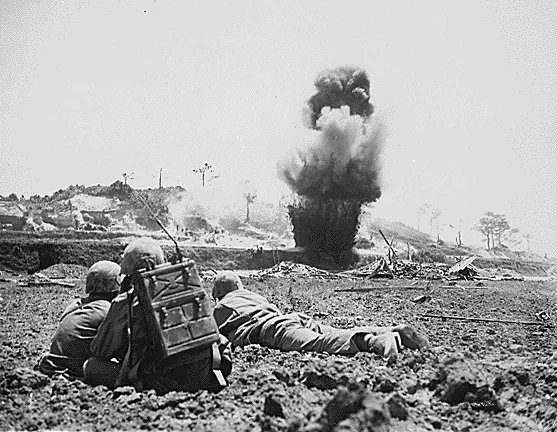
Marines look on as they detonate the entrance to cave networks during the Battle of Okinawa, 1945
The Allies had a choice: proceed with Operation OLYMPIC–an invasion requiring an estimated 600,000 troops to succeed–or give the Japanese government one final chance to surrender.
The Allies opted for the latter, and on 26 July 1945, they issued the Potsdam Declaration. In this joint statement, the Allies presented the terms of surrender and called upon the Japanese government to capitulate. When that didn’t happen, the U.S. dropped atomic bombs on Hiroshima and Nagasaki on 6 and 9 August, respectively.
After the obliteration of two cities with just two bombs, Japanese authorities convened the war council to decide how to proceed. The council was composed of six members, with the Emperor presiding but never voting. This time, the council was split between those who wanted to continue the war effort, and those who were willing to accept the terms of the Potsdam Declaration. For the first time ever, Emperor Hirohito cast a vote, and he decided to end the war.
The Imperial government concluded that the only way to proceed was to take another unprecedented measure, which was to record the emperor’s voice and to broadcast it across the region. Thus, Hirohito traveled to NHK studio in Tokyo to record the “Imperial Rescript on Surrender” in which he would implore his subjects “to pave the way for a grand peace for all the generations to come by enduring the unendurable and suffering what is insufferable.”
But word spread amongst the military in Tokyo that Japan was surrendering. The staff officers who had been raised under the propagandist “Way of the Subject” education system and had spent their entire careers either at war or actively mobilizing for one, could not accept this decision.
On 14 August, a group led by Major Hatanaka Kenji initiated a coup attempt. They assassinated the Eastern Army commander and attempted to eliminate key members of the Cabinet. Further still, they infiltrated the Imperial Household to recover the recording of the Imperial Rescript.
As if to illustrate just how close history came to taking another path, the recording only survived because Imperial household officials hid a copy of it in a laundry basket.
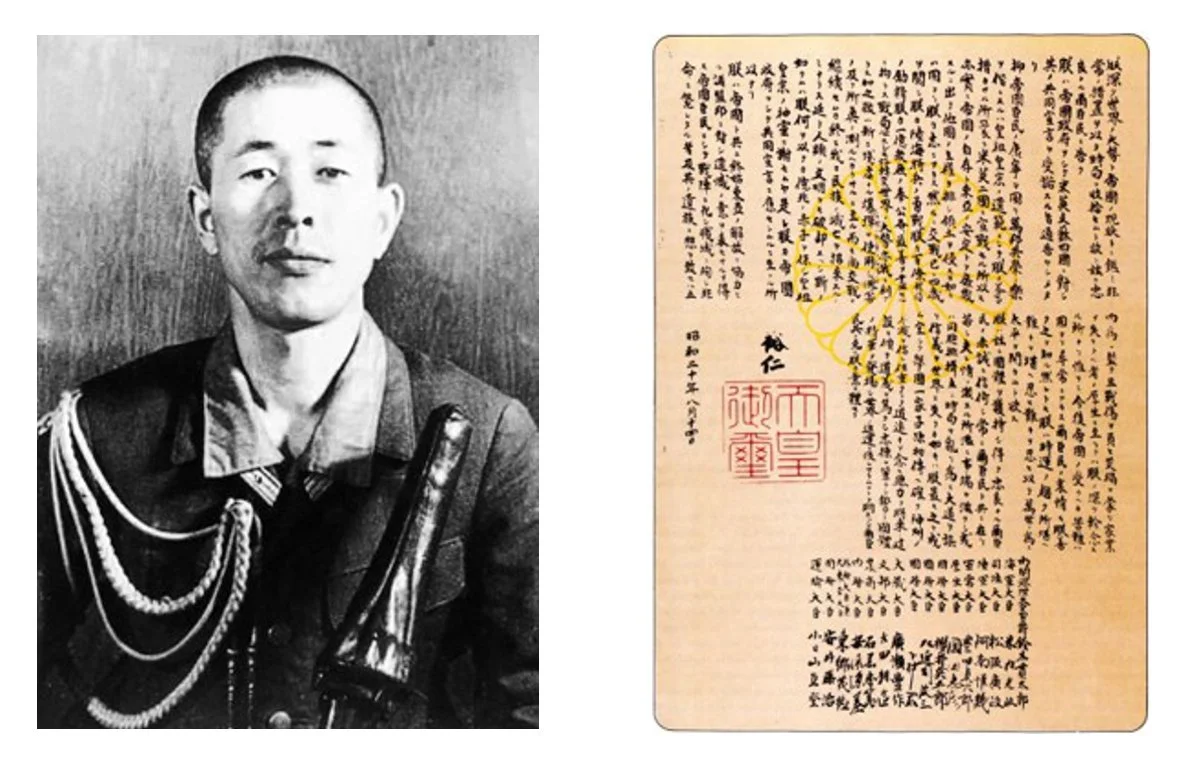
Major Hatanaka Kenji (left); the single-page version of the Imperial Rescript on Surrender (right)
On 15 August, the broadcast went out across the airwaves. After their failed coup attempt, Hatanaka and many of his fellow co-conspirators killed themselves, as did dozens of other soldiers who committed suicide in front of the now-contentious Yasukuni Shrine.
While that would have been dramatic enough to illustrate the complexity of ending the war in Japan, there were eight more major incidents involving riots, coup attempts, and assassination plots between 16 and 24 August. It would take two subsequent Imperial Rescripts–on 17 and 25 August–to calm the situation and enable the formal surrender to take place on 2 September.
In WWII Japan, despite the presence of a system that was supposed to implement imperial orders as if they came from god on high, and even after eight years of constant war, massive battlefield losses, countless air raids, and two bombs, a peaceful end was still not guaranteed.
This story has stayed with me since I first learned about it, and I contemplated its lessons through two deployments in Afghanistan. There, I found myself thinking back to Japan often. Although the military campaigns were separated by decades, technology, culture, and geography, one question rattled around in my skull: how will this war end?
I remember being a young officer watching all the tactical successes on the battlefield amount to no real change in the strategic situation. What I saw during my first deployment to Helmand Province in 2010-11 was no different from when I returned to Kandahar in 2012. If anything, things had gotten worse, as my old base at Camp Bastion suffered the worst attack on an Allied airfield since the Vietnam War.
Today, as I lead the Parley Policy Institute, these same questions continue to shape my work. We examine not only how wars are fought, but how they can be brought to a close in ways that create the conditions for lasting peace. As we look at Russia-Ukraine, U.S.-Iran, Israel-Hamas, and others, we must ask ourselves the critical question of how we want these wars to end, and then we must develop implementable policies aimed at achieving it.
As I do this, the lessons from V-J Day and the failed coup attempt are just as relevant today: Ending a war is always messy, and no matter the costs, there will always be those dissatisfied with the outcomes. History celebrates victory, but the harder—and ultimately more important—challenge is forcing the sun to set on the war itself.
Michael MacArthur Bosack